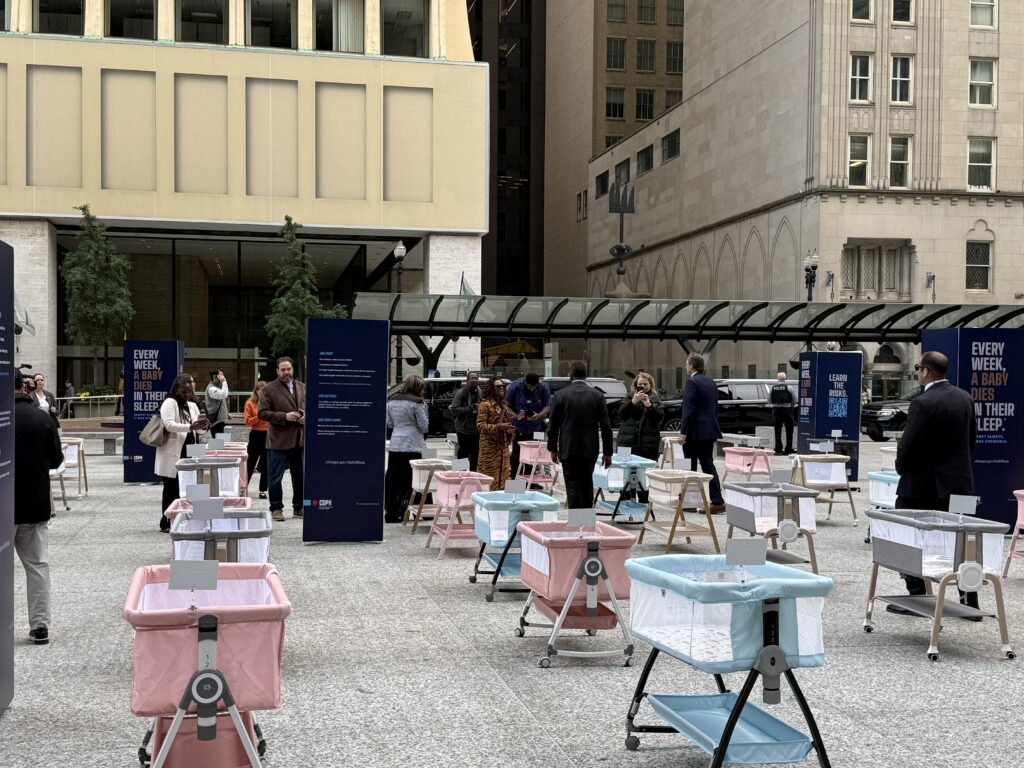

On October 27, the Chicago Department of Public Health filled Daley Plaza with fifty-two empty cribs – one for every week of the year. In Cook County, that’s how often an infant dies suddenly and unexpectedly in their sleep.
What families endure afterward is hard to imagine. Grieving parents relive the worst moment of their lives through interviews, investigation, and autopsy. In doing so, they help build a record that may save someone else’s child.
Dr. Gina Lowell, the Rush pediatrician who leads the Cook County Sudden Unexpected Infant Death Case Registry, spoke about what that record now tells us. Once babies are discharged from the hospital, nothing threatens their lives more than unsafe sleep. Nearly all sleep-related infant deaths are associated with soft bedding, sleeping on a shared bed or couch, or both. Black infants die from sleep-related deaths at fourteen times the rate of white infants, and Hispanic infants at 2.3 times the rate – disparities Dr. Lowell traced to unequal access to resources, information, and bandwidth. The risk comes early, peaking between one and two months of age.
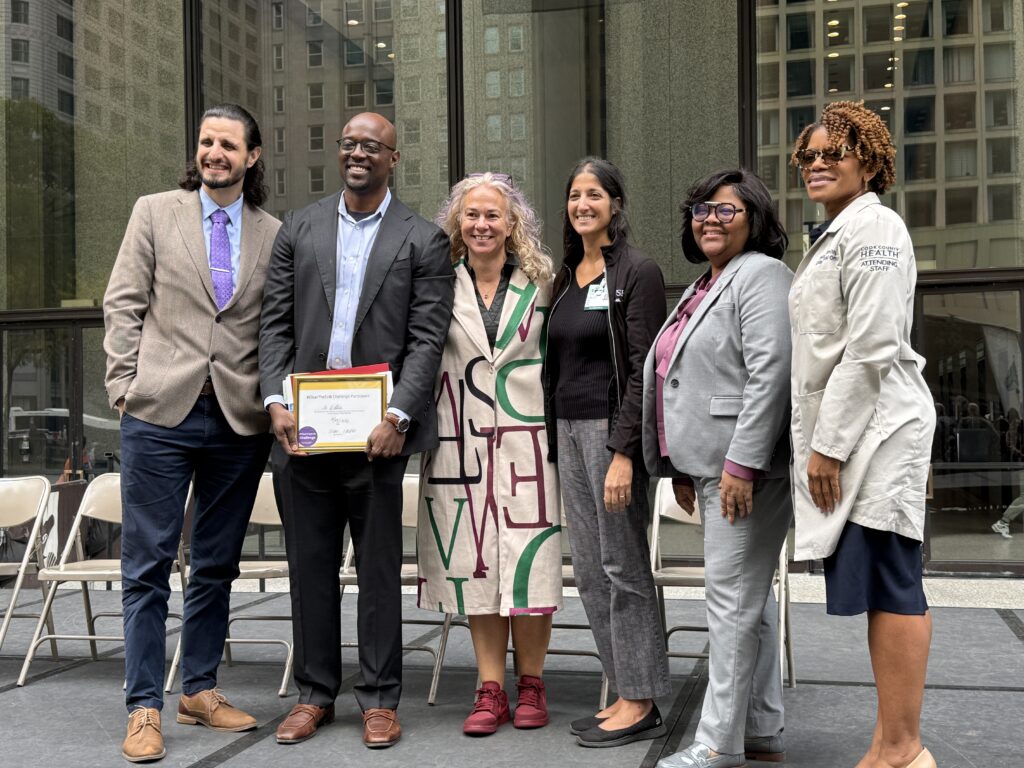
The deaths are nearly always preventable, if a family can be reached in time.
In 2018, the Mayor’s Office and CDPH asked Aim & Arrow to help answer a question: could a universal intervention move the needle on racial disparities in maternal and infant health? Might there be ways to help close the gap on the rates at which Black and Latino babies die, compared to their white peers?
We spent seven months listening to families, maternal and child health experts, and practitioners across the city, pairing what we heard with research on what works. When we worked with the Mayor’s Early Learning Task Force to select Family Connects, Chicago became the first major city to adopt the model. That meant redesigning a program built for a community with roughly 4,000 births a year for a city with more than 30,000. Chicago was also the first to put the elimination of health disparities at the center of its Theory of Change.
Now, every family that delivers at a participating hospital is offered a nurse visit in the first weeks after birth, just ahead of the period when sleep-related risk peaks. The nurse comes to the home, screens for physical and mental health needs, talks through safe sleep and infant care, and connects the family to any resources they might need, with a warm handoff. Because the program is universal, there is no stigma to saying ‘yes’ when a nurse comes to a family’s hospital room to schedule a visit. And once data from those visits are aggregated citywide, we get an incredible snapshot of family needs in the weeks following the birth of a child, and can adapt city resources to better meet them.
The program began in 2020 with four hospitals and 774 home visits. Today, it partners with eleven hospitals and has completed more than 13,400 visits. In 2024 alone, its nurses made more than 4,100 visits and more than 8,000 referrals to diapers, WIC, housing, car seats, child care, and health care. We continue to support its data strategy, program evaluation, community engagement, and sustainability planning.
From Daley Plaza, the cribs will travel to Chicago neighborhoods that have experienced the highest infant loss rates. Family Connects partners, including EverThrive Illinois, UCAN, and Metropolitan Family Services, will carry safe sleep guidance through the people and places families already trust. Meanwhile, Family Connects nurses are already there.